Eating out as a vegetarian should be enjoyable, not an exercise in detective work. Yet restaurant menus are not always designed with vegetarians in mind. Sometimes you will have plenty of interesting dishes to choose from; other times, the vegetarian section consists of a salad, some chips and perhaps a pasta dish that looks suspiciously like an afterthought. Knowing how to navigate these situations makes dining out considerably easier, especially when you are eating with friends, travelling or visiting somewhere you did not choose yourself.
The good news is that you do not need a complicated strategy. A little preparation, a few useful questions and realistic expectations can make a big difference. You also do not have to turn every restaurant meal into a nutritional optimisation exercise. In this article, unlike some of our more nutrition-focused guides, we are concentrating mainly on the social and practical side of vegetarian dining. Sometimes the options are limited, and sometimes you simply want to order something delicious, share a meal with people you like and enjoy your evening.
Check the Menu Prior to Choosing a Restaurant
Looking at the menu before you arrive is one of the most useful habits you can develop. It is not simply about checking whether the restaurant has something marked with a green leaf. Reading the entire menu can tell you much more about how flexible the kitchen is likely to be. If you see mushrooms, roasted vegetables, cheeses, eggs, pulses, sauces and interesting side dishes appearing across several meals, there is usually some room to create or adapt a vegetarian option even when the dedicated vegetarian section looks disappointing.
Checking beforehand is particularly useful when somebody else is choosing the restaurant. You can identify possible meals without having to start negotiating with the group at the table. It also gives you time to contact the restaurant if necessary. A quick phone call can answer questions that menus often cannot: whether a soup contains meat stock, whether a curry paste contains fish ingredients, or whether the kitchen can prepare a vegetarian version of a particular dish. Five minutes of research can prevent twenty minutes of frustration later.
Read Beyond the Vegetarian Symbols on the Menu
Vegetarian labels are useful, but they are not infallible. Some restaurants mark every suitable dish clearly, while others only identify their most obvious vegetarian meals. Side dishes, starters and dishes that can easily be modified may not be labelled at all. When eating vegetarian at restaurants, therefore, it is worth reading the whole menu rather than immediately limiting yourself to the small section headed “vegetarian”.
You may discover that the best meal is hidden elsewhere. Perhaps a mushroom risotto normally comes with Parmesan that can be swapped for another vegetarian cheese. Maybe several Mediterranean starters together make a far more interesting dinner than the single vegetarian main course. A baked potato, grilled vegetables and a substantial salad can sometimes work better than ordering another generic vegetable burger. Think in terms of ingredients and combinations rather than simply accepting the restaurant’s predetermined idea of what a vegetarian meal should look like.
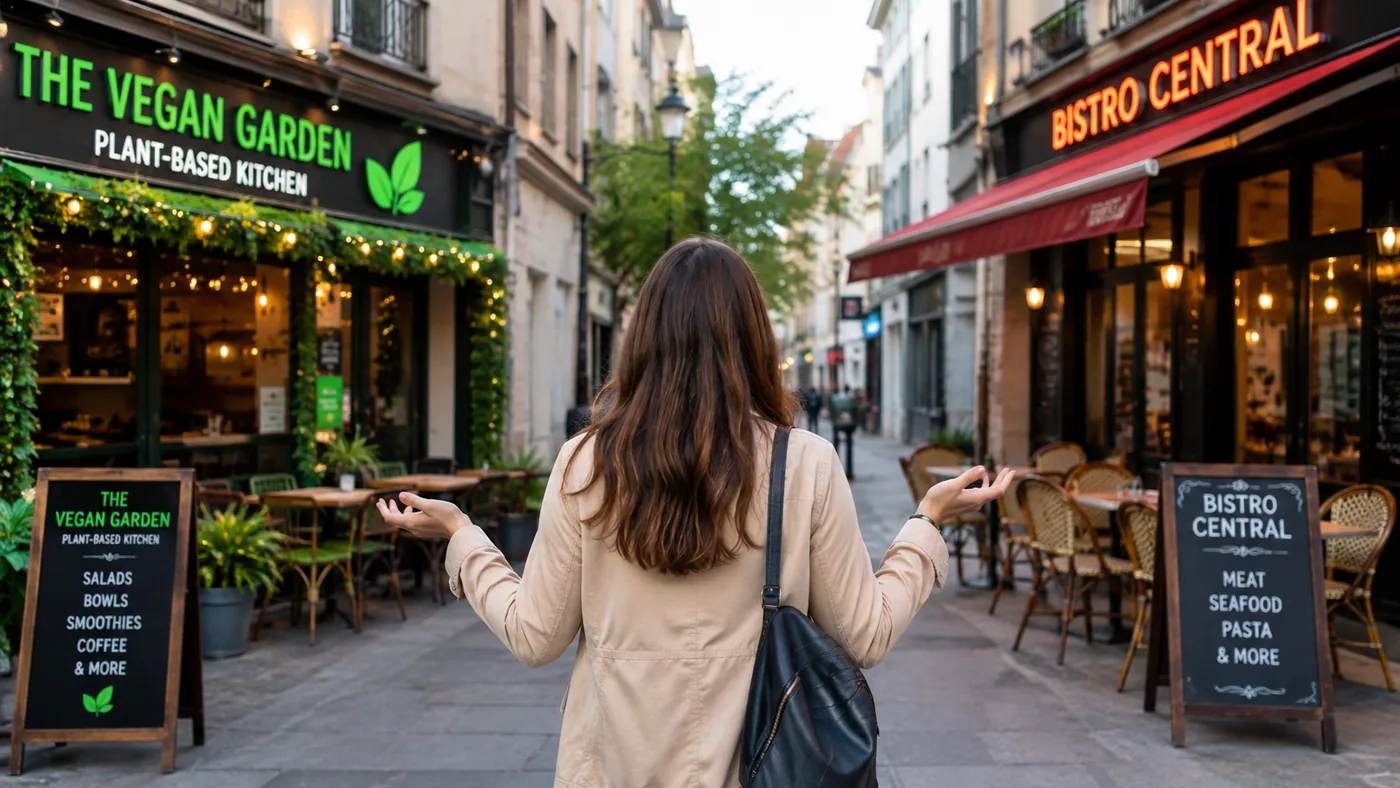
Learn Which Questions Are Actually Worth Asking
You do not need to interrogate the waiter about every ingredient, but certain questions can quickly clarify whether a dish is suitable. Stocks, sauces, dressings and cooking fats are common areas of uncertainty. A vegetable soup may contain chicken stock, for example, while beans might have been cooked with meat. In some cuisines, apparently vegetable-based sauces may contain fish sauce or similar ingredients. Asking specifically about these elements usually gives you better information than simply asking, “Is this vegetarian?”
Try to make the question easy to answer. Saying, “Does the sauce contain meat or fish stock?” is clearer than asking staff to interpret your entire dietary philosophy. If a dish needs modifying, explain the change simply: no anchovies, vegetable stock instead of chicken stock, or extra mushrooms instead of meat. Restaurant staff deal with substitutions every day, and clear requests generally work better than lengthy explanations. You are trying to make everyone’s job easier while still getting a meal you are comfortable eating.
Know When a Simple Vegetarian Substitution Will Work
One of the most useful restaurant skills is recognising which dishes can realistically be adapted. Removing chicken from a salad, for instance, may technically make it vegetarian, but it can also leave you with lettuce and dressing for dinner. A better substitution would replace both the substance and the flavour that disappeared. Eggs, cheese, beans, lentils, tofu, mushrooms, nuts or an extra portion of roasted vegetables may turn the same salad into an actual meal.
The same principle applies to burgers, pasta, tacos, curries and rice dishes. Instead of simply asking the kitchen to remove something, think about what could take its place. A mushroom or grilled halloumi filling may work in a burger; beans or roasted vegetables can replace meat in Mexican dishes; extra aubergine, chickpeas or paneer can transform a curry. The goal is not to recreate meat but to avoid paying full restaurant prices for a meal from which the main component has simply disappeared.
Do Not Automatically Choose the “Healthy” Vegetarian Option
There is a persistent assumption that vegetarian food must also be the lightest option on the menu. It does not. If you want the roasted vegetable salad, order it. If you would rather have mushroom pizza followed by dessert, that is also part of a perfectly normal approach to eating. Going to a restaurant is often about pleasure, company and discovering food, not calculating the nutritional profile of every ingredient.
We have deliberately not concentrated heavily on nutrition in this guide because restaurant choices are sometimes limited, and because enjoying an occasional meal outside your normal routine does not require justification. If nutrition is your priority, our guides to building a balanced vegetarian diet and choosing vegetarian protein sources explore that subject in much greater detail. When you are eating out, however, there is nothing wrong with choosing the dish that genuinely appeals to you rather than automatically selecting the salad because it looks more virtuous.
Build a Meal From Starters and Side Dishes
Some of the best vegetarian restaurant choices are not main courses at all. Restaurants often put more creativity into starters and sides than into their vegetarian mains. A table containing hummus, grilled vegetables, olives, bread, roasted potatoes, cheeses, salads and dips can be considerably more enjoyable than yet another uninspired vegetarian pasta. This approach works particularly well in Mediterranean, Middle Eastern, Indian and many Asian restaurants where sharing dishes is already part of the dining culture.
There is a practical consideration, however: make sure you are ordering enough food. Three small vegetable side dishes may look substantial on paper but still leave you hungry. Ask staff about portion sizes or add something containing eggs, dairy, beans, lentils or another substantial ingredient. Sharing several dishes also works particularly well when other people at the table are happy to order vegetarian food with you. It turns vegetarian dining into part of the group’s experience rather than something happening separately at one end of the table.
Eating Out as a Vegetarian With Non-Vegetarian Friends
The social side of eating out as a vegetarian can sometimes be more complicated than the food itself. You may be perfectly relaxed about your diet while someone else insists on making it the central topic of dinner. Questions are usually harmless, but you are under no obligation to deliver a lecture about vegetarianism while everyone is trying to order. Short, friendly answers are often enough.
It also helps to avoid approaching every restaurant decision as a conflict. If five friends want to visit a particular place and you can see two perfectly acceptable vegetarian options on the menu, insisting that the entire group goes somewhere else may not be worth it. On the other hand, repeatedly accepting restaurants where your only choice is chips is not reasonable either. Good group dining involves compromise in both directions. If this situation feels familiar, our guide to dealing with social pressure as a vegetarian explores how to handle these conversations without making food choices unnecessarily confrontational.
Be Realistic About Vegetarian-Friendly Cuisines
Certain cuisines naturally offer more vegetarian menu options than others, but avoid assuming that every dish from a supposedly vegetarian-friendly cuisine will automatically be suitable. Indian restaurants, for example, can offer an extraordinary range of vegetarian food, while Mediterranean and Middle Eastern restaurants often provide excellent vegetable, pulse and cheese dishes. Italian restaurants usually offer several vegetarian combinations, although ingredients such as certain cheeses may require checking if you follow a stricter vegetarian diet.
Likewise, cuisines that appear difficult at first can sometimes surprise you. A steak restaurant might prepare excellent vegetable sides, salads, baked potatoes and egg-based dishes, while a small local café may happily modify several meals despite having no official vegetarian section. If you are travelling, learning a little about local dishes before you arrive can dramatically improve your experience. Our guide to surviving holidays as a vegetarian goes further into researching local cuisine, communicating dietary requirements and finding good food when you are away from home.
Watch Out for the “Vegetarian Tax”
Removing an expensive ingredient without changing the price is one of the less charming parts of restaurant dining. If a £16 dish contains meat and the vegetarian adaptation simply removes it, you may reasonably wonder why you are still paying £16 for vegetables and rice. Asking whether something substantial can replace the removed ingredient is not being difficult; it is asking for a complete meal.
There is also no requirement to order the designated vegetarian main course if it represents poor value. Compare dishes across the menu. Two starters and a side may offer better food for the same price, while another meal may be easily adapted without losing its main component. Restaurants that genuinely understand vegetarian customers usually design dishes that stand on their own rather than treating vegetarian food as the standard version with something missing. Once you recognise this difference, choosing restaurants becomes much easier.
Have a Backup Plan Without Expecting the Worst
A useful vegetarian habit is having a Plan B without entering every restaurant convinced that something will go wrong. If you know the menu is limited, eat a small snack beforehand rather than arriving extremely hungry. When travelling, keeping a few practical snacks in your bag can also prevent a mediocre restaurant experience from turning into a crisis. This is particularly useful during long journeys, conferences, weddings or organised events where you have little control over the food.
At the same time, give restaurants a chance. Vegetarian options have become increasingly normal in many places, and kitchens can often accommodate straightforward requests. Constantly anticipating problems can make dining out unnecessarily stressful. The aim is preparedness rather than pessimism: know what you can order, ask sensible questions where necessary and then get on with enjoying the meal.
When the Vegetarian Options Really Are Bad
Occasionally, despite your best efforts, the options are simply poor. Perhaps the only vegetarian main is unavailable, the restaurant cannot modify another dish or everything suitable consists of small side portions. In those situations, improvisation is often the most practical answer. Build a meal from starters, order several sides, eat something afterwards or simply accept that this particular dinner will not be memorable.
You do not need to turn one disappointing meal into a broader statement about vegetarianism. Restaurants vary enormously, and a bad menu usually tells you more about that particular kitchen than about vegetarian food. Make a mental note and choose somewhere different next time. If you frequently eat with the same group, suggest restaurants that genuinely work for everybody rather than places that merely tolerate vegetarian customers.
Enjoy the Experience, Not Just the Vegetarian Menu
Ultimately, eating out is about much more than finding technically suitable food. Restaurants are places where people celebrate, talk, travel, date, meet friends and discover unfamiliar flavours. Vegetarianism should fit into those experiences rather than constantly interrupting them. The more comfortable you become reading menus, asking concise questions and recognising adaptable dishes, the less attention the process requires.
You will occasionally order something disappointing… or discover halfway through a conversation with a waiter that the apparently perfect dish uses meat stock. You may also stumble across a tiny restaurant with no vegetarian section that produces one of the best vegetable dishes you have ever eaten. All of these experiences are part of dining out.
Final Thoughts on Eating Out as a Vegetarian
Eating out as a vegetarian becomes much easier once you stop searching exclusively for meals carrying an official vegetarian label and start understanding how restaurant menus work. Check menus beforehand when it is useful, look for adaptable dishes, ask precise questions and make substitutions that create a complete meal rather than simply removing ingredients.
At the same time, keep some perspective. Not every restaurant meal needs to be nutritionally perfect, politically meaningful or worthy of a photograph. Sometimes dinner is just dinner. Choose something you like, enjoy the company and move on.
Vegetarian dining works best when it feels normal. With a little experience, you spend less time worrying about what you can eat and more time deciding what you actually want to eat — which is exactly how going to a restaurant should feel.