A lot of outdated ideas still shape how people talk about vegetarian eating, which is why vegetarian diet myths remain so common. Some people assume a vegetarian diet is automatically restrictive, lacking in protein, or difficult to maintain in everyday life. In reality, most of these beliefs come from old habits, weak information (even certain ideologies), or confusion between a badly planned diet and a well-balanced one. A healthy vegetarian diet can be varied, satisfying, practical, and nutritionally strong when it includes a good mix of vegetables, pulses, grains, dairy, eggs, nuts, and seeds. The issue is not whether vegetarian eating works. The real issue is whether people understand how to build meals properly and stop repeating myths that no longer hold up.
This matters because food choices are often judged through stereotypes instead of facts. Many people still imagine vegetarian meals as plain salads, side dishes, or expensive meat substitutes, when the reality is far broader and much more useful. Good vegetarian nutrition is based on simple principles such as balance, variety, and consistency. It does not require perfection, and it does not need to be extreme. Whether someone chooses vegetarian eating for health, ethics, sustainability, or personal preference, they deserve accurate information rather than lazy assumptions. Once the most common myths are broken down, the vegetarian diet starts to look less like a compromise and more like a solid, realistic way of eating.
Myth 1: You can’t get enough protein
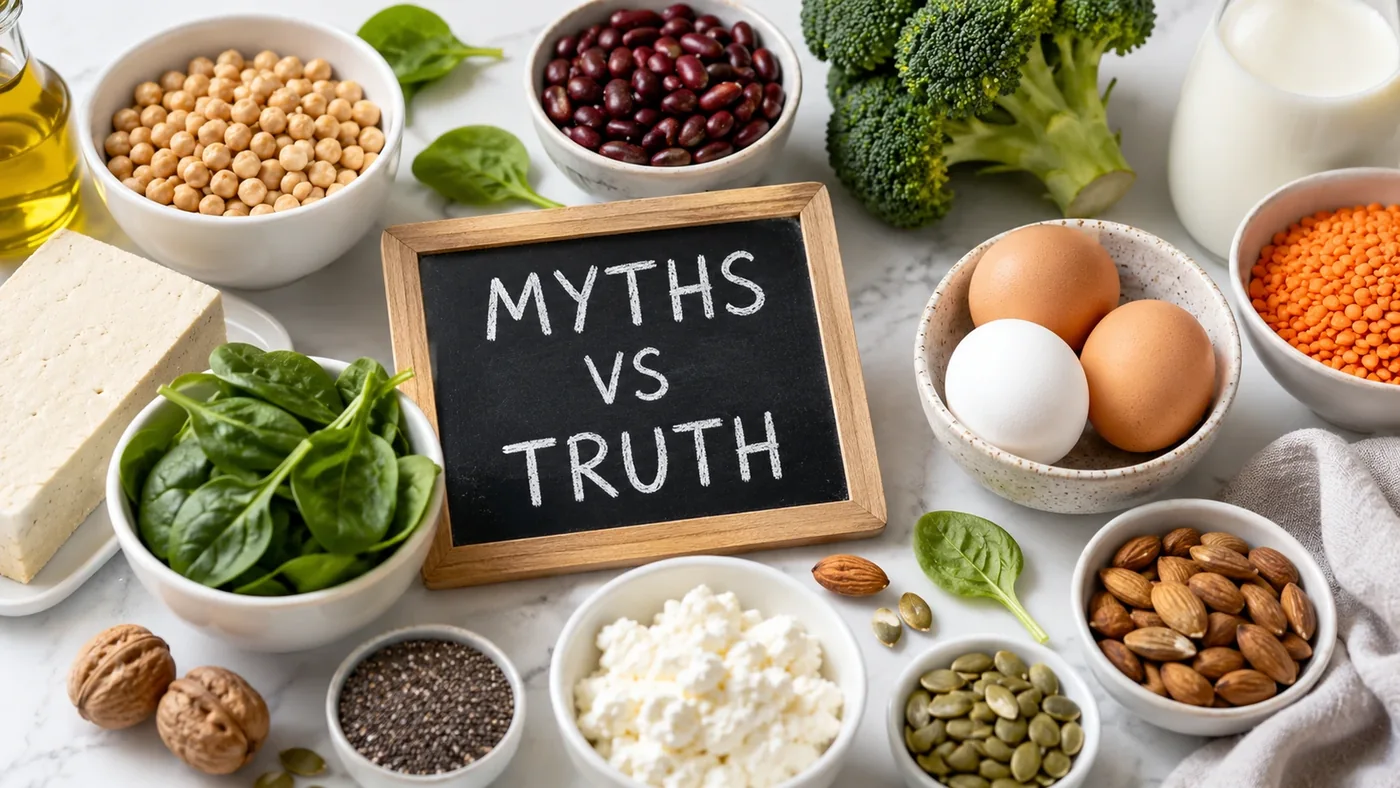
One of the most persistent vegetarian diet myths is the idea that protein only comes from meat. That argument does not survive even basic scrutiny. There are plenty of reliable vegetarian protein sources, including lentils, chickpeas, beans, tofu, tempeh, eggs, Greek yoghurt, cheese, nuts, and seeds.
A vegetarian diet does not need to copy a meat-based plate in order to be complete. It needs a sensible spread of foods across the week. Protein is not some exclusive asset owned by chicken breasts and steaks. In practice, many vegetarians get enough protein without much difficulty because everyday staples already do a lot of the heavy lifting when meals are planned properly.
Myth 2: You’ll become iron deficient
The same applies to iron, although this one needs slightly more nuance. Yes, iron from plant foods is absorbed differently from iron in meat, so it makes sense to pay attention to it. But saying that iron on a vegetarian diet is impossible is simply wrong. Lentils, beans, fortified cereals, pumpkin seeds, spinach, dried apricots, and eggs can all contribute to iron intake.
The smart move is pairing these foods with vitamin C sources such as peppers, broccoli, tomatoes, kiwi, or citrus fruit to support absorption. That is the operational fix. Not panic, not misinformation, just better meal design. A vegetarian diet is not inherently iron-poor. A badly planned diet is the problem, and that is true whether meat is included or not.
Myth 3: Vegetarians always lack B12
Vitamin B12 is often used as a scare tactic in conversations about vegetarian eating, but the reality is more precise than that. Ovo-lacto vegetarians can get vitamin B12 from eggs and dairy foods, and many people also use fortified products depending on how they eat. The important point is not to pretend B12 does not matter, because it does.
The important point is to understand that awareness and planning solve the issue. A well-organised vegetarian approach takes key nutrients seriously instead of acting like everything sorts itself out automatically. That is not a weakness of vegetarian nutrition. It is just part of eating with intention rather than drifting through the week on habit and convenience.
Myth 4: You can’t get omega-3 without fish
The omega-3 argument follows the same pattern of oversimplification. People often assume that if someone does not eat fish, they automatically miss out on everything related to essential fats. That is not accurate. Plant foods such as walnuts, chia seeds, flaxseeds, hemp seeds, and rapeseed oil all help support omega-3 intake, and omega-3 enriched eggs can also contribute in an ovo-lacto-vegetarian diet.
The key message is not that fish and plant sources are identical, because they are not. The key message is that vegetarians still have workable options. The practical answer is to include these foods regularly instead of ignoring the subject. Once again, the myth collapses under basic planning and a more grown-up view of how nutrition actually works.
Myth 5: Vegetarian means healthy by default
Here is where some people on both sides get it wrong. A vegetarian diet is not automatically healthy just because it excludes meat. That is one of the most misleading assumptions in the whole conversation. A diet based on chips, pastries, sugary snacks, white bread, and ultra-processed convenience food can still be vegetarian, but that does not make it balanced. A healthy vegetarian diet depends on food quality, fibre, protein balance, micronutrients, and meal structure.
In business terms, removing one category of food does not guarantee a stronger nutritional model. It just changes the inputs. The outcome still depends on execution. A strong vegetarian pattern includes legumes, wholegrains, vegetables, fruit, eggs or dairy, and nutrient-aware choices across the week.
Myth 6: Vegetarian diet is too expensive
The cost argument is also overplayed. Many people assume vegetarian eating requires premium branded products, specialist health shop items, or expensive meat substitutes every day. That is simply not how most sensible vegetarian households operate. Some of the most cost-effective foods in any supermarket are vegetarian by default: oats, lentils, pasta, rice, beans, tinned tomatoes, seasonal vegetables, eggs, yoghurt, and potatoes.
Meat substitutes can be useful for speed, familiarity, or convenience, but they are not the foundation of the model. They are optional. A practical vegetarian diet often saves money because it leans on basic cupboard staples and flexible ingredients. So the real question is not whether vegetarian eating is expensive. It is whether someone is shopping strategically or outsourcing every meal to branded convenience food…
Myth 7: Being vegetarian is not suitable for children
This myth usually comes from fear rather than evidence. A vegetarian diet can work for children, but like any diet for growing bodies, it needs proper structure. Children need enough energy, protein, iron, calcium, healthy fats, and a good spread of nutrients, so lazy meal planning is not good enough. But that is not a vegetarian problem. That is a poor planning problem.
A child eating a narrow diet of beige convenience food will struggle whether the household is vegetarian or not. The real solution is variety, regular meals, and attention to nutrient-dense foods. Eggs, dairy, beans, lentils, nut butters where appropriate, wholegrains, fruit, and vegetables all have a place in a balanced family food strategy.
Myth 8: Pregnancy and a vegetarian diet are incompatible
Pregnancy raises the same issue in a more serious context, which is why the myth sounds dramatic even when the truth is more straightforward. A vegetarian diet during pregnancy is not automatically risky, but it does demand stronger nutritional awareness. That means paying attention to iron, protein, calcium, iodine, folate, vitamin D, and vitamin B12, while also making sure meals are consistent and sufficient. In other words, this is not the stage for random dieting, skipping meals, or relying on intuition alone.
Still, that is not a reason to dismiss vegetarian eating. It is a reason to approach it properly. Pregnancy already requires more nutritional discipline, and vegetarian women can absolutely meet those demands when meals are well designed and key nutrients are actively monitored.
Myth 9: Vegetarian food is boring
The idea that vegetarian food is boring usually comes from people who have not moved beyond the most basic version of it. If someone thinks a vegetarian meal is always a sad side salad or a plate of under-seasoned vegetables, the problem is not the diet. The problem is a lack of culinary imagination. A vegetarian kitchen can include rich lentil stews, roasted vegetable pasta, mushroom risotto, paneer curry, shakshuka, bean chilli, spinach lasagne, aubergine bake, frittatas, soups, grain bowls, and dozens of other meals with proper flavour, texture, and substance.
Good vegetarian food does not rely on sacrifice. It relies on seasoning, contrast, structure, and smart ingredient pairing. When that is in place, the “boring” label looks weak and outdated.
Myth 10: It’s all salads and fake meat
The same goes for the claim that vegetarian eating means living on salads or heavily processed fake meat. That is a lazy caricature, not a serious description of how most vegetarians actually eat. Yes, salads can be excellent, and yes, meat alternatives have a place for convenience or transition. But neither defines the whole category. A solid vegetarian diet is usually built on staples such as pulses, grains, eggs, dairy, vegetables, fruit, nuts, and seeds. That is the core operating system.
Meat substitutes are just one optional product line within a much wider food landscape. The strongest vegetarian meals are often the simplest ones, built from everyday ingredients that deliver taste, nutrition, and flexibility without trying to imitate meat at every turn.
The truth behind vegetarian diet myths
Most vegetarian diet myths fall apart once the conversation moves from assumption to actual meal planning. A vegetarian diet is not automatically perfect, but it is absolutely capable of being balanced, enjoyable, affordable, and nutritionally sound. The recurring pattern behind almost every myth is the same: people confuse poor planning with proof that vegetarian eating does not work. That logic is flawed. Any diet can fail when it is repetitive, low in nutrients, or built around convenience food. The real benchmark is not whether a diet includes meat. It is whether it delivers variety, key nutrients, satisfaction, and long-term practicality. That is where vegetarian nutrition holds up far better than critics often admit.
The truth is simple. A well-planned vegetarian diet can provide protein, iron, healthy fats, flavour, and genuine everyday flexibility without feeling restrictive or extreme. It can suit families, professionals, students, and anyone looking for a more conscious and balanced way of eating. The biggest value here is not just correcting misinformation. It is helping people see that vegetarian eating is a credible, modern, and realistic option rather than a niche lifestyle built on compromise. Once the myths are stripped away, what remains is a clear message: vegetarian food can be satisfying, nutritious, and entirely workable in real life. That is the truth behind the noise, and it is the only part worth carrying forward.